SLIDER

WELCOME TO BLOGGER'S BOOKSHELF...


where our team of writers love to talk all things books, sharing reviews, features, lists, interviews and more.

Getting lost in a book is escapism at it's finest and it's what everyone who contributes here thrives on.

NEWSLETTER

Far Orbit | Bascomb James | Review

Monday, 30 November 2015

Far Orbit | Bascomb James | Review


Summary:

This book is a collection of short Sci-Fi stories put together to show that Sci-Fi doesn't have to be scary and grim. The future can be bright and even funny. It doesn't have to be all scary aliens, death for humanity, etc.

Review:

I needed this book. I didn't realize how much I needed it until I started reading the stories and realized I was mentally prepping myself for all negative outcomes. Sci-Fi has become littered with depressing stories and this book was just the antidote I needed for all that negativity. 

Almost every story in this book left me feeling better than before I had read it. They are upbeat and hopeful about humanities chances without being sappy. There's still death and destruction, but you root for your heroes and don't feel traumatized afterwards. 

Also, while every story deals with space, each story has a different aspect of space Sci-Fi. One story has a contemporary location and technology. One story is about space pirates. Another story is about space cowboys. There is so much variation on the theme of Positive Space Sci-Fi. It's awesome!

So if you're tired of scary, judgmental Sci-Fi, or if you want a collection of good reads, I highly recommend Far Orbit from World Weaver Press. I was so happy to read this book. It was a buoy in a time of grim, dark reads. 
No comments
Group Collaboration | #WeNeedMore: Books We Want To Read

Saturday, 28 November 2015

Group Collaboration | #WeNeedMore: Books We Want To Read

Some stories are overdone but others have never seen the light of day. This month partly inspired by the #WeNeedMore hashtag and in honour of NaNoWriMo 2016, we had our bloggers think about the books that seem to be missing from the literary sphere. Here's some of the books we feel we need more of...

 ~  -  ~ 

It would be really interesting to see more 'utopian' stories out there, as predominantly it is dystopian futures where underground revolutions rise up against totalitarian governments. I would love to read more stories that were generally more peaceful and the story following kind of a rom com vibe, but also set in the future. The novelist could envisage what time saving technologies, living arrangements, clothes and landscape the future might hold for us. It would be a chance to be creative and inventive in a positive way. 
- Cat 

 ~  -  ~ 

Characters with disabilities need to be shown as 'getting on with it' rather than inspirational.

 ~  -  ~ 

I'd love to see more graphic novels that deal with real, contemporary issues, such as Katie Green's Lighter Than my Shadow, which is about her struggle with mental illness. Graphic novels are an incredibly powerful medium and it would be great to see this format utilised more.
More generally, I found it very difficult to think of topics that are rarely or are not discussed somewhere. Perhaps though, this is due to a lack of diverse voices. If we don't hear them, how are we to know what their stories are? Food for thought from The Guardian
- Ali 

 ~  -  ~ 

YA is so often very romance heavy, so I'd love to see more contemporary YA books focused on friendships and family relationships - especially supportive family environments.
We also talk a lot about wanting more diverse literature but I'd love to see more fantasy, dystopian and sci-fi novels set in East Asia and the Pacific Islands - basically I want a Hunger Games but with Filipino characters please!
- Ria

 ~  -  ~ 

Some fantastic stories from this month's contributors! 
If you have any literary recommendations to satisfy our blogger's needs leave them in the comments!

---------------------------------------------------------------------------------------------------------------------------------------------------------------- 

Next month it's our final group post of 2015 (can you believe it?!) and of course we want to know what your top 5 favourite reads this year! 
If you'd like to get involved just email bloggersbookshelf@gmail.com or drop us a tweet @blog_bookshelf!
No comments

Thursday, 26 November 2015

Features | Reading Outside Your Genre


I can safely say that my favourite reading genre is YA contemporary. I never tire of Meg Cabot, Stephanie Perkins, or John Green, and if someone recommends a YA contemporary novel to me I immediately add it to my wish list, usually without even bothering to read the reviews on goodreads. I thought I might grow out of it at university and develop a taste for more literary genres but I was wrong. I only left university with even more of an appreciation for YA contemporary than I had when I got there. I even wrote my dissertation on it.

I don't think there's anything wrong with having a favourite reading genre. I don't think there's even anything wrong with choosing most of your reading from that genre. That's what genres are for. They exist so that we can easily find books similar in theme and subject to the books we already like. And reading should be fun and enjoyable so if you have a genre that you know you enjoy, why not look there first when you're trying to find something new to read?

However, I also think it's never a bad idea to explore books outside of your favourite genre. If you're a writer, it's essential to experience books from all sorts of genres, so that you can see the common threads of how stories work, and even if you aren't a writer at all I still think that's important for readers. Reading outside of your favourite genre can open up a whole new world of stories you'll love but might otherwise never have known about, and it can also help you to appreciate your own favourite genre more.

There are certain aspects of storytelling that are present in any and every type of genre, and there are other aspects that you will usually only find associated to one, and both of those things can help a reader better understand and appreciate the stories they're already familiar with. Even if contemporary is your thing and you try your hand at fantasy only to discover you don't like it, the contrast could just make you love your contemporary novels even more, so what is there to lose?

What do you think? What's your favourite genre? And how often do you branch out from it to read new things?
No comments
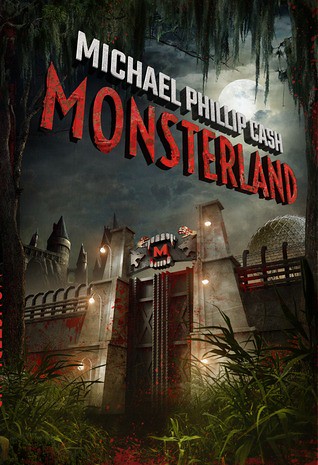
Monsterland | Michael Phillip Cash | Review

Monday, 23 November 2015

Monsterland | Michael Phillip Cash | Review

monsterland1*Review copy c/o Netgalley, image via goodreads.com

In a world where werewolves, vampires and zombies exist, one man’s solution is to open theme parks across the globe, using these various ‘monsters’ as the attractions… and this is how Monsterland is born.

After a chance meeting with the park’s creator Dr Conrad, Wyatt and his friends score tickets to the big opening night of their local Monsterland park and we’re invited along for the ride! What could possibly go wrong?

The intriguing premise, somewhat reminiscent of Jurassic Park, is what drew me in to picking up the novel and I was excited to find out just what would happen when the Monsterland parks launched. Of course, it’s clear right from the start that housing a bunch of so-called ‘monsters’ in a theme park isn’t a good idea, and I really enjoyed finding out just how it would all go wrong.

The book built up to be quite action-packed and had a few twists thrown in along the way. The basic idea of the Monsterland parks would definitely be well-suited to a cinematic adaptation, and I felt the way it was written reflected this.

In all honesty as much I enjoyed the concept, I didn’t love the characters. Although we’re not given a huge amount of background information about what happened leading up to the creation of the parks, we have just enough to follow Wyatt and co. for the opening night of Monsterland. I would have loved to have known more about the world in which the story takes place, as well as our main characters, but I understand that this wasn’t necessary in telling this standalone tale.

Monsterland is a fun novel with an interesting concept and is a great quick read, especially if you’re looking for something a little different. It’s one for you to pick up if you like a little bit of horror - and social commentary!
No comments
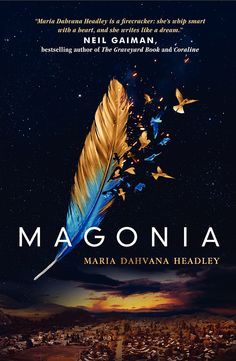
Magonia |  Maria Dahvana Headley | Review

Friday, 20 November 2015

Magonia | Maria Dahvana Headley | Review


Aza Ray is drowning in thin air. 

Since she was a baby, Aza has suffered from a mysterious 
lung disease that makes it ever harder for her 
to breathe, to speak—to live. 

So when Aza catches a glimpse of a ship in the sky, 
her family chalks it up to a cruel side effect of her medication. 
But Aza doesn't think this is a hallucination. 
She can hear someone on the ship calling her name...
[suddenly] something goes terribly wrong. 
Aza is lost to our world—and found, by another. 
Magonia. 


I'm going to say it straight off the bat, and no, it's not really a spoiler. Aza dies. Well, sort of. It's confusing. Aza dies, but awakes on a ship in the clouds, able to breathe clearly and deeply. She is told that she's not actually human, but belongs in this sky-ship world where birds live in their lungs, and magical songs are sung, battles are fought, lives are lost. All while Earth below is (mostly) oblivious to what's going on above the clouds.

There's a bad guy, what seems to be the good guys, a boy (of course), and a best friend left behind. I'm struggling a little to find the words to write this review. It's nothing like I expected, but not in a good way. I was expecting crazy, yes, I was expecting a great new world above the clouds and above the noise and the world...and in most ways I got that, but it was a little too crazy, even for me. The idea of ships in the sky isn't new to me - Stardust anyone? Or The Edge Chronicles? - but the idea that birds could leap in and out of people's chest as easily as walking through a door was a weird one for me. I just couldn't get my head around it. I know with fantasy you can do what you want, but it just was ... guys, it was odd. Magic makes sense to me. Centaurs even make sense. Transfiguration makes sense. Birds living in chests? Ah...

The story in general was fine, and I really liked the beginning. I like Aza's character at the start, and loved her best friend Jason, but as the story went along I got tired of Aza and didn't really feel sorry for her or care for her much at all. It was if it went all downhill (for me) after Aza discovered Magonia and the sky ships and the people there, which is sad, because that's the whole main point of the story. It was beautifully written, however, in first person from Aza's perspective and occasionally from Jason's. There were some beautiful lines and paragraphs within the story, but the way it was written still didn't grip me enough to not get bored by the end of it.

If you liked YA, and fantasy, a bit of drama, a little bit of love, a whole lot of birds and flying ships, totally give this book a go if you haven't already. It was definitely an interesting story, a fresh idea with actual historical references, but not awesome enough for me to love it. Sorry!

It's hard to write this, I think, because so many people loved this book. But at the end of the day/review, it's up to you to read it. It's up to you to decide whether you like it or not.


Have you read it? 
Please tell me you loved it and it's just me who didn't like it. 
What did you think?


Image and synopsis from Good Reads 
No comments

Thursday, 19 November 2015

Features | Do dystopian novels reflect the real world?

Since today was the release of Mockingjay part 2 (in the UK at least), it felt only right that today's post was focused on the Hunger Games.
Warning #1: This post is going to touch on wars and events that are currently going on in the world at the moment. If this is going to upset or scare you please don't read on.
Warning #2: Major hunger games spoilers ahead, especially for the third book

It's easy to read dystopian novels and see them as something that couldn't happen. Whilst a reality TV show where children murder each other is probably a little far fetched, there are definitely parallels between this and historical events, the most obvious being the 1917 Russian revolution. Both started with a heavily capitalist society where the rich are extremely rich but the rest of the people are essentially peasants. They also had similar ruling structure. Then comes the communist rebels. It's clear that district 13's is run under a communist regime, and Coin's intention is to overthrow Snow and enforce a communism upon Panem. This is basically what happened in Russia in 1917. The Bolshevik communists overthrew the Tsar (the Russian king) and seized power for themselves, marking the beginning of Soviet Russia. It's also clear from the book that Coin is corrupted by power, just like the Soviet dictators like Stalin were. Whether Collins deliberately modelled it on the Russian Revolution I don't know (it seems likely to me that she did since the comparisons are fairly obvious). However, it does show that dystopian novels may not be entirely fictional.

Just like with fiction books, it's possible to form a detachment from events that happened a long time ago, and dismiss them as things that would never happen again. With events that are happening today, it's much more difficult. A prime example of this is the current war in Syria. The rebels fighting dictator Al - Assad is not that dissimilar from the rebels fighting the Capitol. Additionally, dictatorships like President Snow's do exist in the real life. It's easy to take freedom of speech for granted living in a western civilisation, but in North Korea political dissidence is a punishable offence.

So is the hunger games just a fiction book, or is it something more? In Thailand, doing the hunger games three finger salute is banned at protests. It's more than just a book. For some people, its become a symbol of resistance. "Dystopia" may not a thing that only exists within the bounds of fiction, and that's scary.

Sorry for the slightly deeper post than usual, hope I haven't freaked anyone out too much!
Katie x

No comments
© Blogger's Bookshelf • Theme by Maira G.