

Monday, 15 June 2015
The Eerie Adventures of the Lycanthrope Robinson Crusoe | Peter Clines | Review
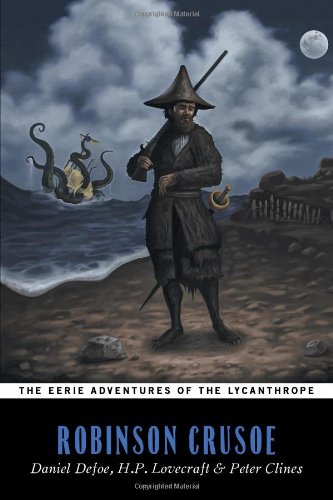
*Image courtesy of Amazon.com
Summary:
Most of us are familiar with the story of Robinson Crusoe, stranded on a deserted island for nearly three decades with only his wit and perseverance to help him survive it's many perils. In this book, Peter Clines takes the original story and combines it with elements of Lovecraft to create a supernatural version of the classic tale.
Review:
I'm almost always a fan of the retelling of classic stories with an unusual twist. Be it Pride, Prejudice and Zombies or Sherlock Holmes in the 22nd Century (90's cartoon). I greatly appreciate when an author is able to breathe new life into a classic story.
To be honest, I only ever read the Great Illustrated Classics version of Robinson Crusoe. As a result, I may have missed some details of the original book that would have made it a lot less boring. To me it was a survival story without a lot of survival but with a lot of luck. That's what I was looking forward to this retelling. Crusoe as a werewolf gives his survival more credibility. It's easier for me to believe that a werewolf could survive almost 30 years on this island as opposed to a regular mortal man.
The inclusion of some Lovecraft elements, predominantly Cthulu, also gave the story a bit more flavor and even some legitimately scary scenes. It also helped to explain why the natives on nearby islands found this particular island to be sacred ground for their church, rather than another island to live on. Clines' inclusion of supernatural elements actually does help the overall story to make more sense than the version of the original that I had read.
Of course, for me, there were still some boring parts. This retelling still stays fairly true to the original, so it's not surprising that there were times when Crusoe's story seemed mundane. But, if you enjoy a classic with a twist, or supernatural elements as commonplace, I definitely recommend The Eerie Adventures of the Lycanthrope Robinson Crusoe. I happily give 4 out of 5.
To be honest, I only ever read the Great Illustrated Classics version of Robinson Crusoe. As a result, I may have missed some details of the original book that would have made it a lot less boring. To me it was a survival story without a lot of survival but with a lot of luck. That's what I was looking forward to this retelling. Crusoe as a werewolf gives his survival more credibility. It's easier for me to believe that a werewolf could survive almost 30 years on this island as opposed to a regular mortal man.
The inclusion of some Lovecraft elements, predominantly Cthulu, also gave the story a bit more flavor and even some legitimately scary scenes. It also helped to explain why the natives on nearby islands found this particular island to be sacred ground for their church, rather than another island to live on. Clines' inclusion of supernatural elements actually does help the overall story to make more sense than the version of the original that I had read.
Of course, for me, there were still some boring parts. This retelling still stays fairly true to the original, so it's not surprising that there were times when Crusoe's story seemed mundane. But, if you enjoy a classic with a twist, or supernatural elements as commonplace, I definitely recommend The Eerie Adventures of the Lycanthrope Robinson Crusoe. I happily give 4 out of 5.



 Mr Penumbra's 24-Hour Bookstore follows Clay Jannon, a web designer recently unemployed during the Great Recession. One day he's out for a walk around San Francisco and comes across the bookstore of the title - a narrow, tall shop with a sign in the window saying "Help Wanted". Feeling intrigued and with nothing to stop him doing so, Clay applies for a job and is accepted as a clerk. He works the night shift from 10pm to 6am. Clay soon discovers that this bookstore is not at all normal or ordinary. At the front of the shops there are your usual genre shelves - sci-fi & fantasy, biography, classics. In the back of the store, where there are three-storey high ladders, there exists a collection of very strange books. At first, Mr. Penumbra tells Clay that he must not open any of these books. Soon enough, Clay realises that there are very few customers wanting the "front of house" books. Instead, his regulars seem to belong to a mysterious club, where membership entitles them to borrow books from the back of the store. Mr. Penumbra instructs Clay to log all of these club-type visitors in a log book, describing anything particular about their appearance or behaviour.
